Fundamentals of Force Calibration

Fundamentals of Force Calibration

  • Start Date : 9 February, 2027
  • Start Time : 1:30pm
  • End Date : 9 February, 2027
  • End Time : 5:00pm
  • Address : Pacific Rm, N Tower

Abstract

A 10 000 lbf S-beam load cell sits slightly misaligned in a machine. It reads 0.75 % off, nobody notices, and the certificate goes out. The expanded uncertainty should have been 9.95 lbf (k = 2), but it’s really closer to 85 lbf. Force measurement happens so often that we take it for granted. Yet nearly everything we use gets tested with a traceable force measurement at some point, from the lumber in your house to the cardboard tube holding your toilet paper.
 
This full-day course covers applied force calibration from the definition of the newton to the conformity statement on the certificate. The morning covers types of force equipment, how to read a load cell specification sheet, and the four steps to the right system: load cell, indicator, adapters, and calibration provider. The afternoon is hands-on with how to create a measurement uncertainty budget for force.
 
Bring your questions and your worst adapter story. We’ll try not to squash any load cells.
 

Learning objectives

  1. Identify common force-measuring instruments and load cell types. Read the key load cell specifications: static error band, nonlinearity, hysteresis, creep, and side load sensitivity. Perform basic load cell troubleshooting.
  2. Demonstrate how alignment, adapters, thread engagement, top block hardness, cable configuration, and mass-to-force corrections change calibration results, and measure the size of each effect.
  3. Choose the right load cell, indicator, adapters, and calibration provider for an application, including recognizing when two-point TEDS linearization falls short of polynomial coefficients.
  4. Build an ASTM E74 uncertainty budget, and use guardbands and decision rules to make statements of conformity you can defend.
Henry Zumbrun - MSC

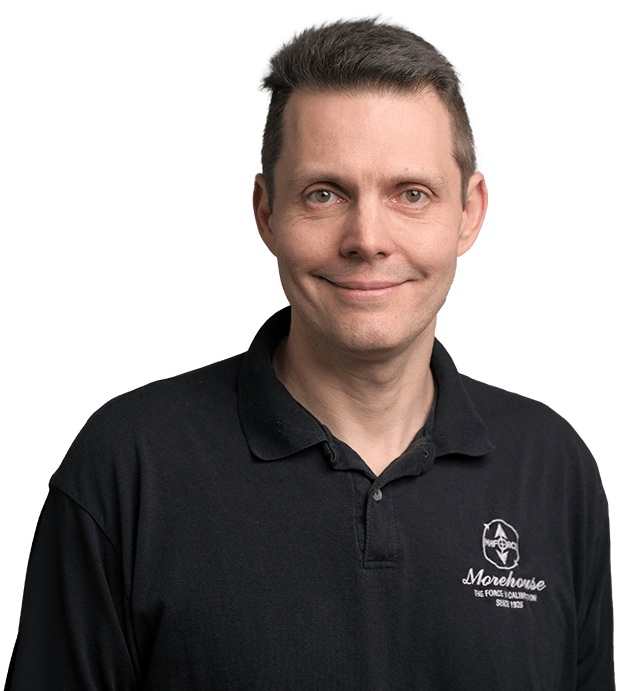
Henry Zumbrun

Henry Zumbrun is CEO of Morehouse Instrument Company, a force and torque calibration manufacturer and ISO/IEC 17025 accredited lab founded in 1920. Since 2015, Morehouse has more than doubled its staff and been named a Best Places to Work five years running. Henry has taught at NCSLI, MSC, ASQ, A2LA, and more. Henry wrote Force Calibration for Technicians and Quality Managers, was the primary author of A2LA G126, Authored 2 Chapters in the Metrology Handbook, and serves on ASTM Committee E28 as the technical advisor for ASTM E74 and E2428. He is old enough that he never received a participation trophy.